Ligature Response and Basic Life Support | Face-to-Face Course
This one-day course is for staff who work where ligature incidents are a foreseeable risk and who do not already hold a current first aid certificate. That includes mental health wards, psychiatric units, prisons, probation, refuges, children’s homes and some residential care services.
The CQC expects services to train staff, reduce environmental risk and respond when an incident happens. This course covers ligature response and Basic Life Support in one day, so you can act from the first approach through to CPR and AED use.
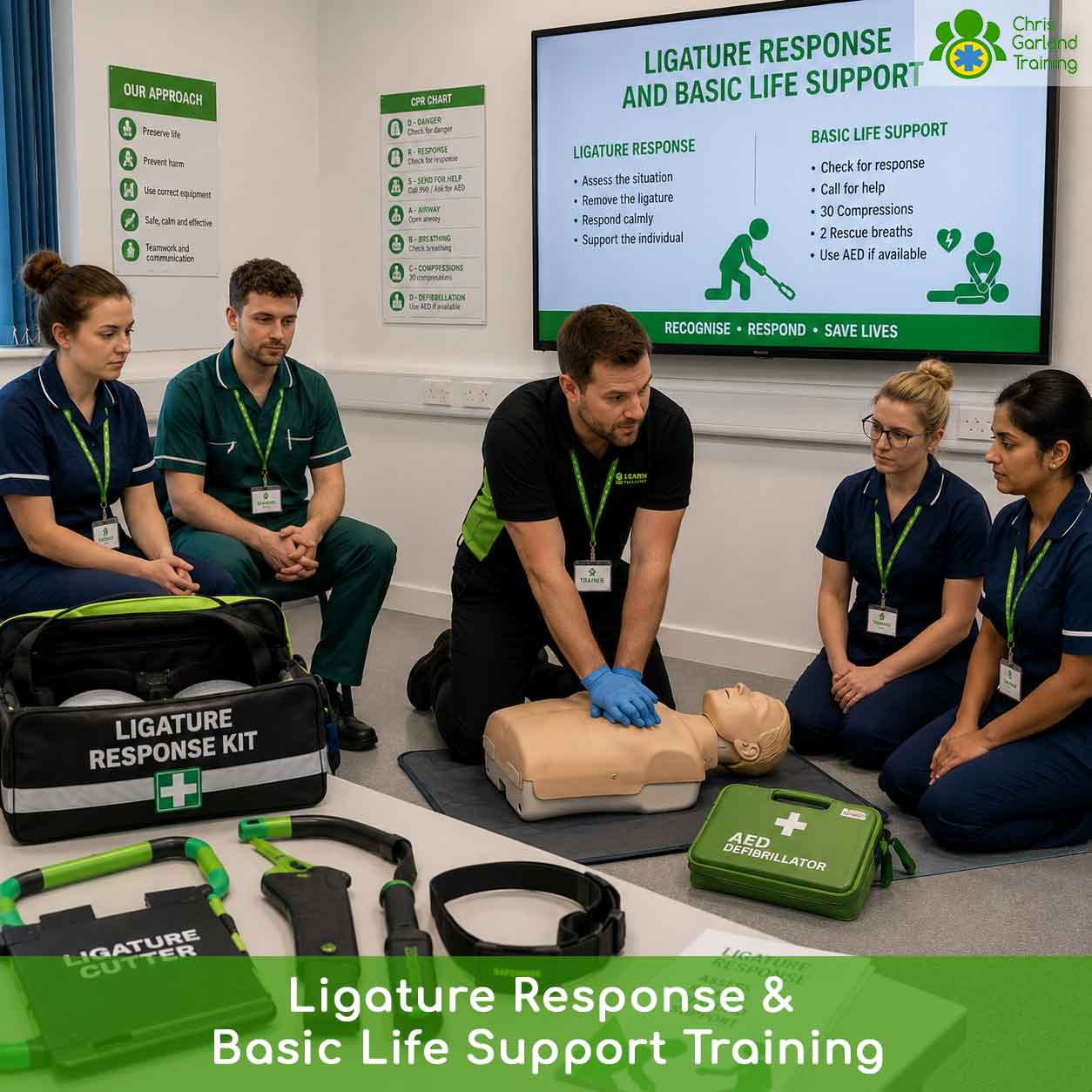
It is not theory only; you practise approach, cutting tools, airway care, CPR, AED and what to do after the event. We use drawings and X-rays during the course, not graphic photographs. We do however describe what a rescuer may face in the time of need.
You learn jaw thrust as well as head tilt, chin lift, and a spinal variant of the recovery position. Every ligature incident is treated as a possible spinal injury.
If you already hold a current first aid certificate, book the half-day Ligature Response Training instead.
Want the warning signs first? Read Ligature Response: How to Identify and Respond to Warning Signs.
Working in a home-like care setting? See our case study on balancing comfort and ligature safety.
If your team also closes wounds after an incident, look at the half-day Wound Closure course.
What You Will Learn
1. Ligature response
- Who this is for: staff in mental health, secure, residential, refuge and children’s settings where ligature risk is foreseeable.
- Definitions: hanging, strangulation and suffocation, including fully suspended, part suspended and unsuspended casualties.
- Facts and figures: what the current UK data tells us, without turning the morning into a statistics lecture.
- The neck: why airway, blood flow and the cervical spine are at risk, and why you treat every incident as a possible spinal injury.
- Signs of ligature injury: what you may see and what that means for first aid.
- Risk in your setting: rooms, fixtures and items that create opportunity.
- Tools: how to choose and use the cutters and hooks your service issues.
- Fully suspended casualty: call for help, scene safety, take the weight, cut, lower.
- Part-suspended casualty: support the upper body, take the strain off the ligature, cut, lower.
- Unsuspended casualty: remove the ligature and start first aid.
- Practical: cut a ligature with the right tool, under instructor watch.
- After the incident: scene preservation, incident form, who you notify, and looking after the team.
2. Basic Life Support
- Spinal first aid: how to spot a possible spinal injury and limit movement to what is needed to save life.
- Primary survey: DRCABCDE, following Resuscitation Council UK 2025.
- Airway: jaw thrust and head tilt, chin lift.
- Recovery position: standard and spinal variant.
- CPR: adult, adolescent and child sequences, including after a ligature incident.
- AED: how to use an automated external defibrillator.
- Choking: response for a blocked airway.
Course Details and Assessment
This course is face to face only. Tool handling, CPR and rescue practice need an instructor in the room.
- Duration: 7 hours, including breaks (about 6 hours of teaching).
- Open course times: 9:00am to 4:00pm.
- Group size: maximum 12 learners per instructor. Open courses need a minimum of 4 learners to run.
- Assessment: continuous practical observation. Practical pass mark 100%.
- Physical demand: you must be able to work on the floor and demonstrate CPR.
- Certificate: Chris Garland Training PDF certificate on a pass.
Resuscitation follows Resuscitation Council UK 2025. This day gives you Basic Life Support for a possible spinal injury. It does not replace a full Emergency First Aid or First Aid at Work certificate if your role needs one.
Most services refresh ligature skills every year. Book the Ligature Response Annual Refresher when certificates are due.
Who Can Attend
- Minimum age 18.
- No first aid certificate is required. This course includes Basic Life Support.
- You need to be able to work on the floor for the practical.
- Teaching and assessment are in English. As a guide, Level 1 or GCSE Grade D literacy helps. Contact us before booking if you need a reasonable adjustment.
Which Ligature Course Do You Need?
- No current first aid certificate: this one-day course.
- Current first aiders: half-day Ligature Response Training.
- Annual update: Ligature Response Annual Refresher.
Venues and Private Bookings
Open courses run at our training centre in Knutsford, Cheshire. Read the joining instructions for times, parking and what to wear.
A private course on your site is usually the better option. We can set scenarios around your rooms and the tools your staff actually carry.
Every course plants a tree. See our Social Value and Sustainability page. Request a private quote on the Corporate and Bespoke Training Quotations page.
Related Training and Guides
- Half-day ligature only: Ligature Response Training
- Annual refresher: Ligature Response Annual Refresher
- Warning signs: How to identify and respond to warning signs
- Residential care: Balancing domestic comfort and ligature safety
- Safeguarding: Safeguarding Adults | E-learning
- Emergency First Aid at Work: EFAW
- BLS instructor update: Basic Life Support Instructor Refresher
- Joining notes: Joining instructions
- Social value: Social Value and Sustainability
- FAQs: FAQ page
- Group size rules: Terms, conditions and policies