Forest School First Aid Course | 3-Day Face-to-Face
Forest school and beach school sessions present unique, multi-environment first aid challenges. For example, casualties range from infants and young children to adult supervisors. In addition, operations take place in remote outdoor settings where emergency access can take up to two hours.
Standard workplace, outdoor, or paediatric qualifications do not cover all these complex variables on their own. Therefore, our comprehensive three-day course satisfies all three regulatory frameworks simultaneously. Specifically, this intensive training explicitly exceeds the Institute for Outdoor Learning Level 4 first aid recommendations.
The Forest School First Aid course I attended was excellent. Chris is a superb, knowledgeable trainer. There was the perfect blend of theory, practical and challenging scenario practise work. Since passing the course I have dealt with all the grazes, bumps, cuts, friction burns and stings etc one expects to encounter in an outdoor theme/adventure park. Recently I was able to treat a child with a broken arm and make them comfortable with a sling as Chris had trained me to. This course has given me the knowledge, skills and confidence to assess and deal with first aid situations where I work and elsewhere. Highly recommended.
Statutory Compliance & Unified Accreditations
This qualification carries extensive multi-sector accreditation values. Specifically, it completely covers the full core syllabi for three essential standard courses. These include the 16-Hour Outdoor First Aid and the 12-Hour Paediatric First Aid tracks. In addition, it incorporates the 6-Hour Emergency First Aid at Work framework seamlessly. Consequently, both Ofsted and the Independent Schools Inspectorate accept this certification without reservation.
Forest School leaders can satisfy multiple statutory workplace duties simultaneously through this single training window. However, if taking three full days away is challenging, you can consider our alternative option. Specifically, our popular Forest School First Aid (Blended Learning) course shifts the theory modules online fluidly.
How the 3-Day Training Timeline Works
We deliver this premium qualification entirely through immersive classroom and practical interaction. For example, the intensive curriculum provides a deep dive into wilderness emergency systems over a dedicated schedule.
- 20+ Guided Learning Hours: Regulatory bodies demand a minimum of 20 in-person contact hours to validate this multi-framework certificate. Therefore, our expert trainer guides you through every required module in person across the days. This targeted time explicitly covers your assessment profiles and completely excludes rest breaks.
- Self-Directed Study: Furthermore, the awarding bodies recommend an additional four hours of independent self-study. This material helps reinforce your theoretical understanding of remote emergency planning before final checks.
- The 3-Day Standard: We deliver this course as standard over three consecutive days. Meanwhile, we occasionally receive client requests to compress this material into two 10-hour days. However, our extensive training experience consistently shows that extreme compression limits learning thresholds. Therefore, we maintain our strict three-day educational standard to protect your practical skill retention.
Extreme Environment & Advanced Protocols
Our practical training modules adapt strictly to real-world wilderness emergencies. In addition, we cover changing environmental hazards dynamically during these drills. For example, you will master modified CPR protocols designed specifically for drowning or avalanche burials.
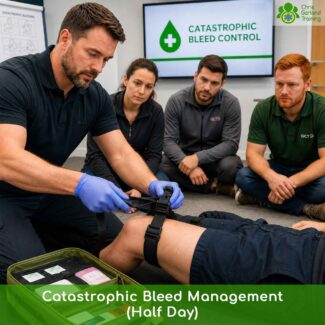
Furthermore, the curriculum addresses lightning strikes, catastrophic bleeding management, and hypovolaemic shock conditions. Subsequently, delegates practice handling suspension trauma, safe tick removal tools, and Lyme disease tracking paths.
Our practical scenarios enforce comprehensive primary and secondary surveys across all casualty demographics. Following current Resuscitation Council UK guidelines, you will practice vital life support skills. This includes care for infants, children, adolescents, and adult casualties to cover your requirements seamlessly.
Comprehensive Course Syllabus
This intensive course covers an extensive array of life-saving topics. Specifically, the modules ensure you remain competent across outdoor, childcare, and commercial settings:
- Assessment & Scene Management: Understand the specific role of a Forest School first aider clearly. Learn to manage safe outdoor scenes, obtain consent, and prevent cross-infection risks. Furthermore, master incident log documentation and communicate effectively with frightened casualties.
- Critical Life-Threatening Emergencies: Practice infant, child, adolescent, and adult CPR techniques thoroughly. Learn modified life-saving protocols for environmental drowning, avalanche entrapment, and lightning strikes. In addition, master complete Automated External Defibrillator operation seamlessly. Learn to manage unresponsive casualties when emergency assistance is up to two hours away. Subsequently, learn to manage severe choking blockages effectively in the field.
- Trauma & Environmental Injuries: Treat major wounds, external bleeding, and catastrophic haemorrhages safely on site. Manage shock, hypovolaemic complications, and suspension trauma fields effectively. In addition, treat environmental burns, scalds, water immersion, and head concussions. Care for suspected spinal, skeletal, or pelvic fractures under delayed evacuation parameters. Finally, master the safe removal of outdoor activity equipment and casualty movement techniques.
- Acute Medical Conditions: Recognise and treat severe allergic reactions and acute anaphylaxis shocks promptly. Manage asthma attacks, diabetic emergencies, heart attacks, strokes, and febrile seizures. Furthermore, identify meningitis symptoms and sudden poisoning or ingestion hazards. Learn to treat foreign bodies in the eyes, ears, or nose safely.
- Outdoor Hazard Tracking: Identify and manage wilderness-specific medical conditions carefully. This includes monitoring for Lyme disease following tick bites and treating adder stings. Additionally, learn to manage deep hypothermia or extreme heat stroke hazards. Treat minor cuts, bruises, or splinters effectively in the field.
Attendance Continuity & Late Arrival Policy
Regulatory awarding bodies enforce strict contact-time criteria for multi-framework compliance certificates. Therefore, you must arrive fully prepared for each interactive module. If you arrive more than 15 minutes late for any training day, we must turn you away. Consequently, late arrivals immediately forfeit their course placement and all paid booking fees.
Classroom Schedule & Daily Breaks
We structure the face-to-face days to maximise your learning and comfort. Specifically, the training runs promptly from 9:00am to 5:00pm each day. Consequently, we distribute approximately one hour of total rest breaks throughout each day. This balanced setup keeps candidates fresh and focused.
- Morning: 15-minute scheduled coffee and comfort break.
- Lunchtime: 30-minute allocated break for lunch.
- Afternoon: 15-minute scheduled coffee and comfort break.
Assessment & Testing Criteria
We assess candidates across two distinct classroom components. These strict rules apply regardless of your chosen certification route:
- Multiple-Choice Question Paper: You sit a formal summative theory exam paper during your course. Candidates must score a minimum of 70% correct answers to achieve a pass.
- Continuous Practical Observation: Our instructor assesses your hands-on techniques throughout the day. Specifically, you must demonstrate life-saving procedures accurately to pass. Act exactly as you would in a real wilderness emergency, performing floor-level CPR. Consequently, this component requires a 100% pass mark.
Certification & Add-On Level 3 Credentials
We provide flexible certification pathways to match your specific organisational requirements perfectly. For example, our default path issues digital PDF credentials through Chris Garland Training. These standard certificates remain valid for exactly three years.
Alternatively, you can select an externally validated, QNUK Ofqual-regulated certificate using the options above. Following this choice, the regulated route includes an official paper certificate and plastic verification card.
Do you need independent verification for distinct workplace roles? Upon request, we can issue separate, standalone Level 3 certificates. Specifically, these options cover Emergency First Aid at Work, Paediatric First Aid, and Outdoor First Aid formats.
We apply a nominal administrative charge for extra printings issued directly by Chris Garland Training. Alternatively, we apply a regulatory fee when requested via the Awarding Organisation.
Course Prerequisites & Age Requirements
Please ensure all attendees meet these physical and educational criteria before arriving at our training centre:
- Physical Capability: You must be physically capable of demonstrating floor-level procedures on training manikins. This includes kneeling to perform continuous physical techniques in simulated outdoor conditions. Therefore, you must meet this mandatory safety requirement to pass the qualification.
- Language Requirement: We conduct all training, technical materials, and assessment papers strictly in English. Therefore, you need a functional level of English to complete the course. As a guideline, we recommend GCSE Grade C or Level 2 literacy and numeracy backgrounds. In addition, you are welcome to bring a physical, paper translation dictionary to the classroom. Please contact our team before booking to discuss reasonable adjustments.
- Age Parameters: This course suits anyone aged 16 or over who wants to assume nominated outdoor first aider duties. Meanwhile, we welcome younger candidates aged 14 to 16 to attend safely. They will receive a valid certificate upon passing the assessments. However, employers should not rely on them as a sole, nominated responsible person.
Candidate Numbers & Group Parameters
We maintain strict educational safety standards. Therefore, we operate clear participant thresholds to ensure every student receives dedicated tutor feedback.
- Minimum Group Size: We require a baseline of four candidates to run an open public course or private session. For open courses, if this threshold is not met, we will contact you to discuss options.
- Maximum Group Size: The Health and Safety Executive and awarding organisations limit our sizes strictly. Specifically, we allow a maximum of 12 candidates per instructor to maintain safe tracking dynamics.
- Larger Corporate Teams: Do you have more than 12 candidates? Specifically, we can easily bring a second qualified assessor into the classroom to accommodate your team. This helpful service depends on calendar availability and requires an additional instructor fee.
Venues, Private Bookings & Global Coverage
Our open, scheduled courses take place at our dedicated training centre in Knutsford, Cheshire. Our instructors travel nationwide to deliver private training directly at your venue or workplace.
Please review our comprehensive Joining Instructions page to check venue directions and parking layout rules. In addition, you can check specific outdoor clothing recommendations on that tracking page.
We gladly adapt our practical scenarios to align with your team’s specific environment and internal risk assessments. Consequently, you can visit our Corporate & Bespoke Training Quotations page to book a private session.
In addition, you can request a custom price breakdown on that submission portal. To learn more about national outdoor infrastructure standards, visit the official website for The Forest School Association.
Related Training and Compliance Guides
We provide multiple alternative training formats and legal safety updates to support your outdoor team workflows perfectly.
- Kitchen Hygiene: Review catering site safety frameworks on our face-to-face Level 2 Award in Food Safety (face to face) course.
- Outdoor Catering: Cooking meals during your woodland camp shifts? Review our specialized Outdoor Food Safety (Level 2) training path.
- Targeted Forestry: Working basic lower-risk woodland roles? Explore our focused Emergency First Aid at Work +Forestry certification track.
- Emergency Mobility: Prepare your facility teams for unexpected building evacuations by booking our active Evacuation Chair Training module.