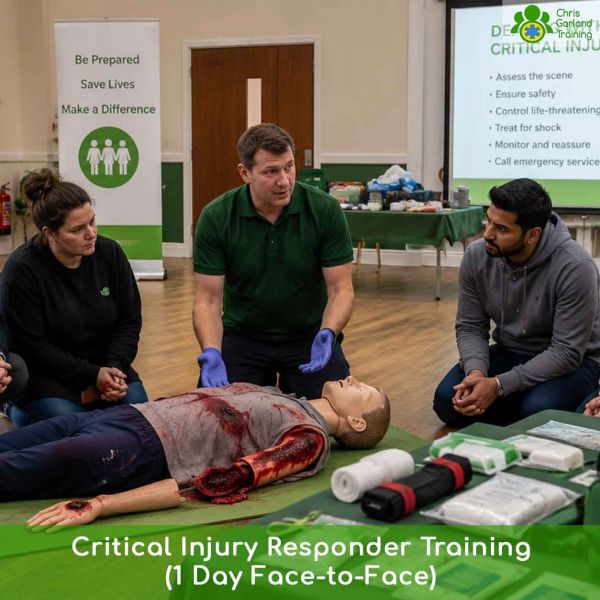
Critical Injury Responder Course | 1-Day
Violent vehicle accidents, industrial mishaps, and ballistic incidents occur unpredictably across the UK. Specifically, knife attacks and gunshot trauma represent real risks for specific operational groups. Therefore, you might find yourself acting as the sole responder during critical incidents. This critical timeframe is widely known as the rescue vacuum.
Our intensive one-day Critical Injury Responder course helps you to handle these extreme medical situations safely. Specifically, this course introduces the official British Standard BS8599-1 compliant Critical Injury First Aid kits. This means that you will learn how to apply specialised trauma assets before paramedics reach your location.
If you feel your team requires a more extensive curriculum, consider an alternative framework. Specifically, you can review our longer Critical Injury Responder Course (12 hours) option instead.
This training suits teams working in high-risk or hostile environments. For example, sports shooting clubs, security operators, and tree surgeons benefit heavily. Furthermore, construction teams and forestry workers operate under these strict hazard profiles. Crucially, if you want to expand beyond our basic Catastrophic Bleed Management course, this pathway is ideal.
What You Will Learn
Our advanced curriculum updates in line with British Standard BS8599-1:2026 frameworks. You can read more about these updates by visiting our HSE First Aid requirements guide online. Specifically, the modules cover these critical fields:
- Trauma Physiology: Understanding the vascular system, blood volumes, hypovolaemia, and the pathophysiology of clotting.
- The Lethal Triad: Evaluating how hypothermia, coagulopathy, and acidosis impact critically injured casualties.
- Triage Systems: Implementing the Ten Second Triage principles under pressure.
- Ballistic Trauma: Treating gunshot trauma, entry and exit wounds, and complex blast injuries safely.
- Severe Burns: Managing deep thermal burns and corrosive chemical or acid attacks effectively.
- Penetrating Wounds: Stabilising knife attacks, deep stab wounds, and traumatic limb amputations cleanly.
- Advanced Assets: Applying specialised chest seals, arterial tourniquets, and commercial haemostatic dressings properly.
- Wound Packing: Executing packing techniques safely within deep cavity wounds to stop haemorrhages.
To expand your clinical knowledge on managing heat trauma, review our latest analysis online. For instance, read our comparison guide Clingfilm vs. Traditional Burn Dressings: Which is Better? for more insights.
Course Details and Assessment Framework
We deliver this high-intensity programme entirely through face-to-face interaction. By its very nature, this course covers disturbing topics including catastrophic bleeds. Therefore, candidates should prepare for realistic trauma imagery throughout the session.
The course provides seven guided learning hours plus standard breaks. Generally, our training sessions run from 9:00am until 5:00pm at our facility. We verify your candidate competence through continuous practical observations during scenario drills.
If you want standalone training practice later, you can also join our Practical Trauma Exercise module safely. Consequently, successful graduates receive a Chris Garland Training certificate via digital PDF.
Prerequisites and Safety Candidate Caps
Candidates must be over 18 years old to attend this advanced trauma care course. Candidates must be aged 18 or over to register for this course. You must hold a formal first aid qualification to attend, the minimum being the emergency first aid at work certificate. Additionally, you must be physically capable of demonstrating procedures on the floor to pass.
We limit attendee numbers to ten delegates per instructor. This restriction helps you to secure excellent individual guidance. If you require a booking for a larger groups, please contact us.
Venues and Private Club Bookings
Our scheduled public sessions run regularly at our modern facility in Knutsford, Cheshire. Please explore our dedicated Joining Instructions page to check local parking rules before arrival. Alternatively, our instructors travel nationwide to deliver private club training.
We gladly adapt the scenarios to match specific ranges or operational environments. Consequently, please complete our Corporate & Bespoke Training Quotations Form to request a private group quotation.
Related Training and Compliance Guides
We provide multiple alternative training formats and legal safety updates to support your team workflows perfectly.
- Course Selection: Not sure which advanced trauma track matches your operational risks? Read our detailed FAQ page.
- Extended Curriculum: Explore advanced clinical modules by reviewing our full 2-day Critical Injury Responder Course (12 hours) track.
- Scenario Practice: Refine your incident management skills by booking our simulated Practical Trauma Exercise module.
- Burn Treatment: Study advanced clinical guidelines on our emergency resource page Clingfilm vs. Traditional Burn Dressings: Which is Better? right now.
- Participant Parameters: Learn more about open session activation thresholds by visiting our Number of Participants legal page.