At A Glance:
The new BS 8599-1:2019+A1:2026 workplace first aid kits standard came into force on 30 April 2026. This critical amendment changes how businesses satisfy HSE first aid requirements 2026 UK regulations. Specifically, employers must move away from basic headcount tracking. Instead, you must implement a documented, risk-based approach to protect your workforce.
Key Takeaways for Immediate Compliance:
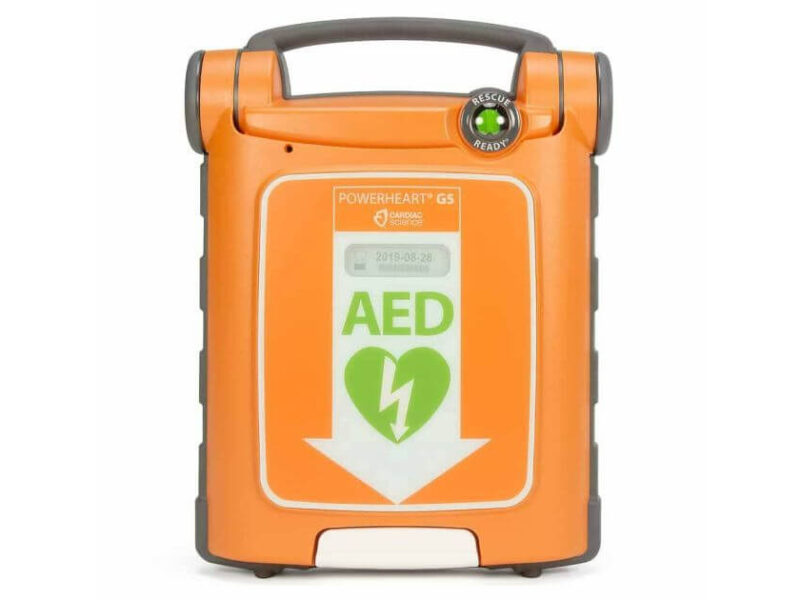
• The Two-Minute AED Rule: Any site with five or more people present should provide a defibrillator. This device must be retrievable and ready to use within two minutes from any location on the premises.
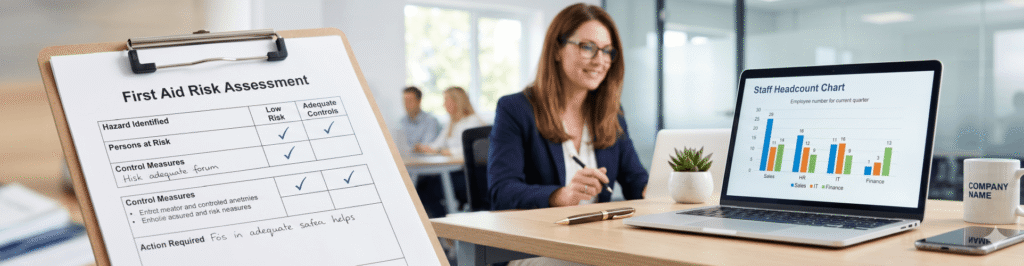
• Written Risk Assessments: If your total business headcount reaches five or more employees, you are legally mandated to record your first aid risk assessment in writing.
• Remote and Mobile Staff: Your statutory duty of care follows your team. Consequently, you must review the first aid kit requirements for remote home workers and supply compliant kits for all company cars.
• Specialist Hazard Kits: Standard first aid boxes are no longer enough if your environment carries specific risks. You must supply dedicated burns kits or eye wash stations if these hazards exist on site.

Is Your Workplace Compliant with the BS 8599-1:2026 First Aid Standard?
To ensure your business remains safe and legally protected, you must keep up with the latest HSE first aid requirements 2026 UK regulations. Specifically, on 30 April 2026, the British Standards Institution released an update known as the BS 8599-1:2019+A1:2026 workplace first aid kits standard. This amendment changes how organisations handle health and safety, switching from a basic headcount check to a detailed, risk-based approach. To begin the year with confidence, employers must understand how this update influences their legal duties and whether they require advanced equipment like defibrillators.
To help you determine exactly what you need, we’ve included a scenario-based FAQ section at the bottom of this blog. We’ve also created a freely downloadable First Aid Needs Assessment Checklist that you can use to help assess your workplace.
Table of contents
- Is Your Workplace Compliant with the BS 8599-1:2026 First Aid Standard?
- Understanding the Legal Foundation of First Aid Compliance
- Do I Legally Need a Written First Aid Risk Assessment?
- 2019 vs. 2026: What Has Changed in the Standards?
- Technical Content Differences Between the Kit Versions
- The Three Most Urgent 2026 Compliance Updates
- Selecting the Right Path for Your Team
- Frequently Asked Questions
Understanding the Legal Foundation of First Aid Compliance
To build a safe work environment, you must know how statutory law connects to British Standards. A British Standard is a code of best practice rather than an act of parliament. However, the Health and Safety Executive (HSE) uses these standards to judge whether your business is meeting its legal duties. Consequently, ignoring them leaves your business exposed to heavy liability if an accident occurs. Your primary duties are rooted in three key pieces of legislation and one official regulatory framework.
The Health and Safety at Work etc. Act 1974 (Section 2)
Under Section 2 of this foundational statute, every employer owes a strict statutory duty of care to ensure, so far as is reasonably practicable, the health, safety, and welfare of all employees. Crucially, this protection is not limited to your physical office walls. When an employee carries out tasks on behalf of your company, their immediate environment is legally classed as a place of work. This includes individuals sitting at a laptop in their spare room or driving to a client meeting in a company vehicle. Consequently, your safety responsibilities follow them wherever they go.
The Health and Safety (First-Aid) Regulations 1981 (Regulation 3)
Regulation 3 of this statute explicitly states that an employer must provide adequate and appropriate equipment, facilities, and personnel. This setup ensures that your employees receive immediate attention if they are injured or taken ill at work. Because the legal definition of being “at work” includes remote settings and mobile duties, employers must systematically factor these flexible environments into their corporate first aid arrangements.
The Management of Health and Safety at Work Regulations 1999 (Regulation 3)
This regulation creates a universal safety duty for British businesses. It states that every employer must make a suitable and sufficient assessment of the risks to the health and safety of their employees. This assessment must evaluate the specific hazards present in the daily working environment and outline the exact control measures implemented to mitigate those risks.
The HSE L74 Approved Code of Practice
To understand how to apply these rules to flexible working, employers must consult the official L74 Guidance on Regulations. The L74 code mandates that your first aid needs assessment must explicitly account for travelling, remote, and lone workers. For travelling staff and company cars, the L74 code dictates that if an employee’s work involves being regularly on the road, the employer must identify the need to keep a personal first aid kit in the vehicle. For home workers, the code notes that basic domestic first aid supplies are sufficient for low-risk, desk-based tasks. However, the employer must still legally document this review within their company-wide risk assessment to prove compliance.
Do I Legally Need a Written First Aid Risk Assessment?
A common and dangerous misconception is that small businesses are entirely exempt from health and safety assessments. This is incorrect, as the duty to evaluate hazards applies to every organisation, even if you only have one employee. However, the exact answer to the question, do I legally need a written first aid risk assessment, depends entirely on your total workforce headcount.
The Employee Count Threshold (The Rule of Five)
The requirements regarding written records are divided by a clear employee threshold:
- Fewer than 5 employees: You must still assess workplace risks and implement control measures, but you are not legally required to record your findings in writing.
- 5 or more employees: You are legally mandated to record the significant findings of your risk assessments in writing. You must also maintain a written corporate health and safety policy.
When calculating your headcount, you must look beyond your full-time staff. To remain fully compliant, you must count full-time workers, part-time staff, temporary or seasonal workers, and casual teams. If your total across these groups reaches five or more, a paper trail is a strict legal necessity.
Why a Written Record is Critical for Small Teams
Even if you manage a small team with fewer than five employees, the HSE strongly recommends keeping a written record. If a serious accident occurs on your premises, a verbal agreement offers no protection. A documented, dated assessment serves as your primary line of legal defence. It proves to inspectors and insurers that you have proactively fulfilled your statutory duty of care.
2019 vs. 2026: What Has Changed in the Standards?
The workplace has shifted dramatically due to hybrid working models, an ageing workforce, and longer emergency service response times. While the 2019 standard focused on updating box contents, such as removing old safety pins and adding modern microporous tape, the 2026 update introduces far bigger structural changes.
The table below breaks down the major shifts between the two frameworks:
| Feature / Focus Area | The 2019 Standard | The 2026 Amendment (A1:2026) |
|---|---|---|
| Primary Metric | Kit size determined mostly by employee headcount. | Provisions determined by a realistic, documented risk assessment. |
| AED Provision | Treated as an optional safety luxury. | Expected on all sites with 5 or more regular occupants. |
| Specialist Kits | Burn and eye wash items were optional add-ons. | Formal requirement if specific hazards are identified on site. |
| Written Logs | Basic record of kit checks and headcount. | Demands a written justification of your exact first aid setup. |
Technical Content Differences Between the Kit Versions
To maintain a compliant workspace, you should understand how the internal specifications differ. The 2019 standard established the standard small, medium, and large kit setups. It also introduced travel and motoring kits, personal issue packs for lone workers, and critical injury packs featuring tourniquets and haemostatic dressings for catastrophic bleeding.
The 2026 amendment does not change the internal contents of those individual 2019 boxes. Instead, it expands the scope of the standard to formalise the physical deployment of advanced life-saving equipment. Specifically, it brings the two minute AED rule for workplaces into full force. It also dictates that businesses cannot rely on a standard first aid box alone if their environment carries unique risks like heat, chemicals, or flying debris.
The Three Most Urgent 2026 Compliance Updates
The new amendment introduces three practical changes that employers must action immediately to protect their staff and remain compliant.
1) The Two-Minute Defibrillator Threshold
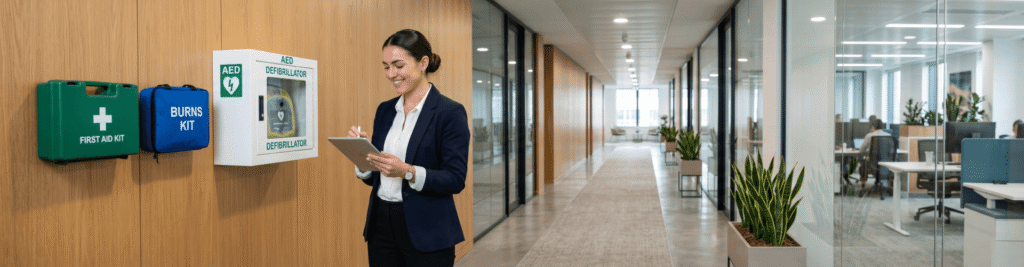
The standard now states that any business with five or more people on site during operating hours should provide an AED. This calculation includes staff, customers, and visitors. Crucially, the device must be accessible within two minutes from any location on the premises. This time framework allows one minute to locate the device, and one minute to prepare it for the casualty. Consequently, large, multi-storey, or sprawling buildings will likely require multiple AED devices to meet this strict time limit.
2) Mandatory Specialist Hazard Kits
Employers must now tailor their equipment to real-world risks. If your workplace carries a risk of burn injuries (such as commercial kitchens or engineering workshops) a dedicated burns kit is a formal requirement. Similarly, if your staff handle chemicals or work in dusty spaces, you must supply dedicated eye wash stations.
3) Justified and Documented Planning
You can no longer simply buy a generic first aid box to tick a box. The 2026 amendment requires you to document your first aid needs assessment if you have five or more workers. You must be able to justify exactly why you have chosen certain items and why you have omitted others based on your unique workplace layout.
Selecting the Right Path for Your Team
Equipment is only effective if your staff have the confidence to use it. We provide clear training pathways to help you satisfy these new British Standards easily.
If this new update means you are installing a defibrillator for the first time, our short, practical Basic Life Support course is the perfect choice. This session gives your team the hands-on skills needed to respond calmly in a cardiac emergency.
To ensure your designated first aiders understand the latest emergency protocols, you can choose between our core workplace qualifications:
- Emergency First Aid at Work (1 Day): Perfect for lower-risk environments like small offices or retail shops. First Aid Course in London
- First Aid at Work (3 Days): Essential for higher-risk settings, larger workforces, or workplaces with complex machinery.
Contact Chris Garland Training today to discuss your first aid needs assessment or to book a training course directly at your venue.
Frequently Asked Questions
Commercial businesses are generally expected to fund their own safety equipment. However, if you manage a school, a community hub, or a business willing to place an AED on an external wall for public use, funding options do exist. Organisations like the British Heart Foundation and various local authorities frequently run grant or match-funding programmes for Public Access Defibrillators. We advise checking the Resuscitation Council UK portal or contacting your local county council to see what active schemes are available in your area.
Legally, the Health and Safety (First-Aid) Regulations 1981 focus on protecting your employees. However, the overarching Health and Safety at Work etc. Act 1974 imposes a strict statutory duty of care on all employers. You must conduct your operations in a way that protects non-employees, including your pupils and visitors, from health and safety risks. Consequently, the Department for Education and the HSE expect you to include pupils in your first aid needs assessment. Regarding the two-minute rule, large school campuses will face physical challenges. You may need an additional AED for your sports hall or distant buildings. Alternatively, trained staff can carry a portable AED out to the playing field during sports days to ensure you maintain compliance.
To begin, the 2026 standard sets the threshold for an AED at five or more people on site. Because you have three employees, it is not an explicit expectation under BS 8599-1. Furthermore, under the Management of Health and Safety at Work Regulations 1999, you are exempt from the legal duty to record your risk assessment in writing because you have fewer than five staff members.
However, you must still verbally review your risks. If your office welcomes regular clients or is located in a remote area where an ambulance might be delayed, writing down a basic assessment and investing in an AED remains a highly recommended step to fulfill your broader Section 2 duty of care.
Your legal duty of care travels with your workforce. To begin, the Resuscitation Council UK (RCUK) 2025 guidelines and the European Resuscitation Council (ERC) 2025 guidelines explicitly state that all homes and cars should be equipped with a first aid kit. Consequently, if you provide company cars for staff travel, or employ home workers, you must make provisions. Under the HSE L74 Approved Code of Practice, employers must supply a compliant, compact vehicle first aid kit for all company cars used for business. For home workers, you must verify that their domestic space has a basic safety kit. If your company has five or more employees in total, you must formally log this remote work review within your written first aid needs assessment to satisfy your Regulation 3 duties.
To begin, having a public defibrillator nearby is excellent for community safety, but it rarely satisfies your workplace compliance duties if you have five or more people on site. The 2026 British Standard requires an AED to be accessible and ready to use within two minutes. Most public high street cabinets are locked. To open them, a member of your staff must run outside, call 999, wait for the operator to provide the keypad code, open the box, and run back inside. This sequence almost always breaches the two-minute time framework. Furthermore, because you do not own or control the public device, you cannot guarantee it is regularly maintained or that another emergency has not already removed it. Consequently, relying on a public unit leaves a gap in your safety planning. To secure true peace of mind and satisfy an HSE inspection, installing your own dedicated internal AED is the safest course of action.
Legally, statutory health and safety regulations focus primarily on workplaces and paid employees. However, community groups, event organisers, and sports committees still owe a strict common-law duty of care to their volunteers, members, and the general public. To begin, your public liability insurance provider will usually expect your group to follow recognised codes of best practice. Following the BS 8599-1:2026 standard is the most reliable way to prove you have taken reasonable steps to protect people. For sports clubs and community festivals, ensuring rapid access to a defibrillator and having volunteers trained in basic life support is vital for participant safety.
To begin, a standard office kit is rarely enough for high-risk environments where manual work takes place. The 2026 standard places a heavy emphasis on realistic risk profiling. If your needs assessment identifies severe hazards from heavy machinery, power tools, or sharp materials, you must look beyond basic supplies. Specifically, the safety framework highlights the use of Critical Injury Packs. These specialised packs contain tourniquets and haemostatic dressings designed to halt catastrophic bleeding immediately. Consequently, relying solely on a generic office box could leave your onsite team unprotected and your business legally exposed under the Health and Safety (First-Aid) Regulations 1981.
Yes, and choosing a single provider is the most efficient way to ensure consistent compliance across your entire organisation. Managing multiple locations can easily leave a health and safety manager feeling overworked, especially with the strict new two-minute AED rules. By partnering with a dedicated safety consultant, you can standardise your risk assessments. We can review each of your locations, establish identical safety baselines, and deliver unified training programmes. This approach gives you complete peace of mind, satisfies your Section 2 duties, and significantly simplifies your corporate administration.
To begin, inspectors will look for evidence of active planning rather than just checking a physical box on your wall. If you employ five or more people across your business, the authorities will legally expect to see a written, documented first aid needs assessment. Specifically, the inspector will verify that you have physically tested the two-minute AED deployment rule. They will also check that your first aid kits are clean, fully stocked, and that no sterile items have passed their expiry dates. Showing a dated, written safety log proves to the authorities that you take your statutory duty of care seriously, helping to protect your business from penalties.