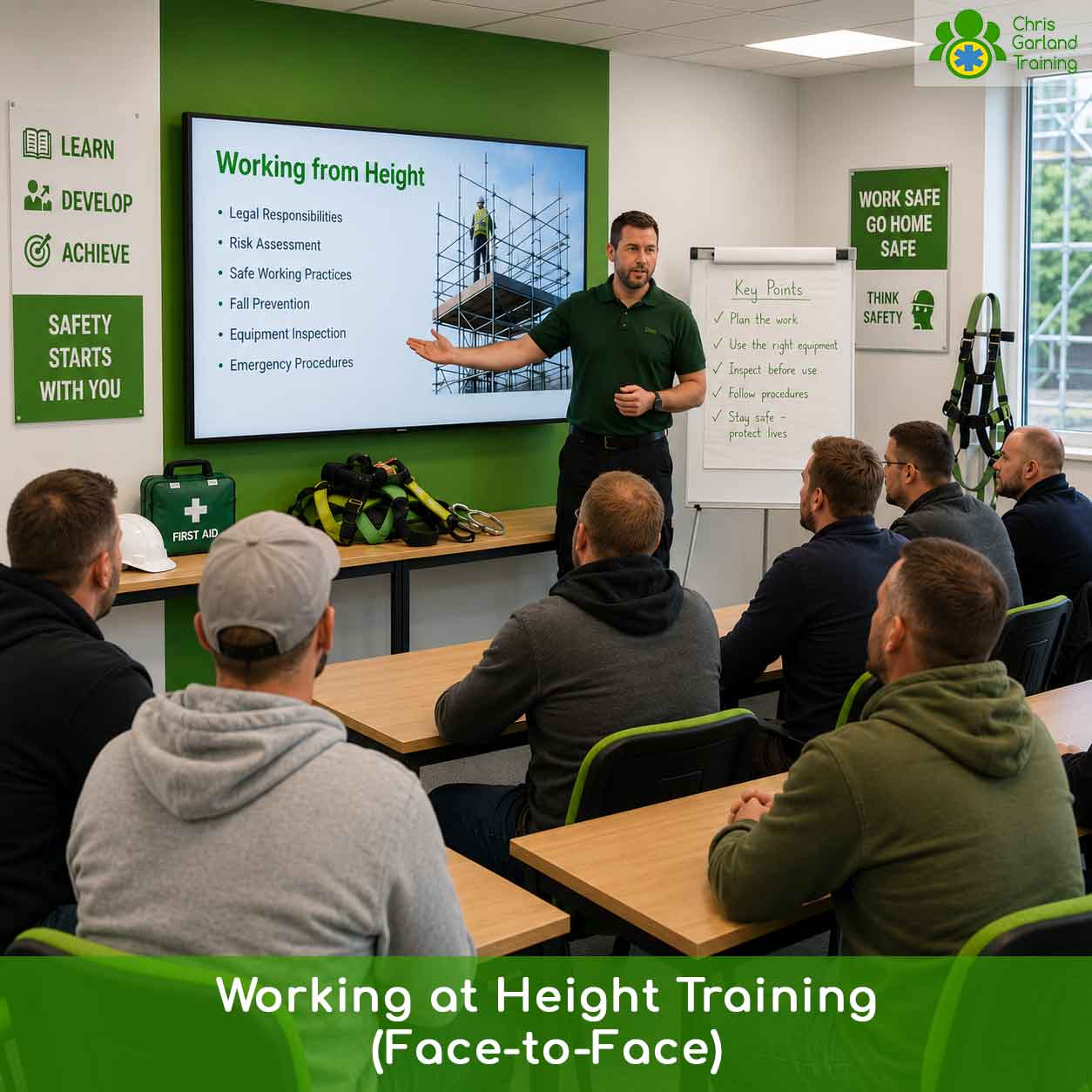
Working at Height Training | Face-to-Face Course
All working at height situations are covered by strict statutory frameworks. Specifically, the Work at Height Regulations 2005 confer critical duties on modern organisations. Therefore, employers and employees must systematically assess, control, and minimise site hazards. This face-to-face course helps you to comply with these essential rules smoothly.
Our specialised training targets anyone who undertakes tasks above ground level. For example, the term applies to platforms, ladders, scaffolds, and stages. In addition, working alongside deep trenches carries identical legal classification. This is because the crucial concept is not how far you climb, but how far you can fall.
Furthermore, falls do not exclusively involve workers dropping from elevated positions. If heavy materials or tools drop, they present equally catastrophic hazards to individuals below. Consequently, learning comprehensive containment methods helps you to prevent accidental field injuries.
What You Will Learn
Our intensive half-day syllabus addresses structural safety planning and risk mitigation. Specifically, the training modules cover these core clinical and industrial fields:
- Regulatory Foundations: Understanding the Work at Height Regulations 2005 along with current health and safety laws.
- Planning Layouts: Organising and planning elevated work tasks systematically to avoid unnecessary dangers.
- Emergency Protocols: Establishing clear, actionable emergency procedures to handle site incidents promptly.
- Competence Standards: Defining the legal parameters of a competent person within industrial environments.
- Employee Duties: Reviewing individual worker responsibilities to maintain mutual field protection safely.
- Surface Hazards: Identifying fragile surfaces, restricted danger areas, and falling object tracking vectors.
- Inspection Regimes: Implementing statutory equipment inspection regimes to maintain operational compliance.
Course Details and Assessment Framework
We deliver this comprehensive framework through immersive face-to-face interaction at our facility.
- Duration: The course provides four guided learning hours with recommended self-study.
- Daily Schedule: Public sessions run cleanly from 9:00am until 1:00pm.
- Testing Rules: Candidates must complete a formal multiple-choice theory paper, requiring a 70% pass score.
- Certification: Successful delegates receive an official Chris Garland Training certificate active for three years.
We schedule open courses regularly at our dedicated centre in Knutsford, Cheshire. Please view the booking selector above to review live dates, current availability, and pricing matrices. In addition, you can check exact morning start times there.
Prerequisites and Safety Candidate Caps
Candidates must be at least fourteen years old to undertake this safety qualification. Meanwhile, we recommend a baseline guideline background of GCSE Grade D literacy. We conduct all technical instructions and assessment papers strictly in English. Therefore, delegates require a functional understanding of the language to participate.
Open scheduled courses require a minimum of four candidates to run successfully under our corporate guidelines. Meanwhile, health and safety rules limit cohort sizes to twelve delegates per instructor. This configuration helps you to secure excellent individual guidance during risk mapping exercises.
Venues and Private Corporate Bookings
Our open scheduled sessions run at our training centre in Knutsford, Cheshire. Please explore our dedicated Joining Instructions page to check directions before arrival.
Alternatively, our experienced instructors travel nationwide to deliver private corporate courses at your premises. We gladly adapt practical scenarios to match your specific facility layouts. Consequently, please complete our Corporate & Bespoke Training Quotations Form to request a quotation.
Related Training and Compliance Guides
We provide multiple alternative equipment inspection tracks to support your team safety workflows perfectly.
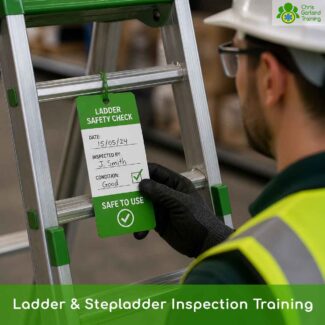
- Inspection Specialisms: Responsible for statutory equipment logging? Book our Ladder and Step Ladder Inspection Training track.
- User Handling: Train your active operators by registering them for our Ladder and Stepladder User Safety Training module.
- All-In-One Protection: Access our combined Ladder and Step Ladder Use and Inspection Training block.
- Safety Limits: Learn more about open session activation thresholds by visiting our Number of Participants legal page.
- Course Options: Not sure which safety framework matches your industrial hazards? Explore our helpful FAQ page.