School Allergy Awareness Training | Benedict’s Law Course
Give every adult on site the skills to spot anaphylaxis and act in minutes. This four-hour face-to-face course helps your school meet the allergy safety duties now in force under Benedict’s Law.
Need to train a large staff team first? There is also a blended version: one-hour e-learning plus a practical classroom session.
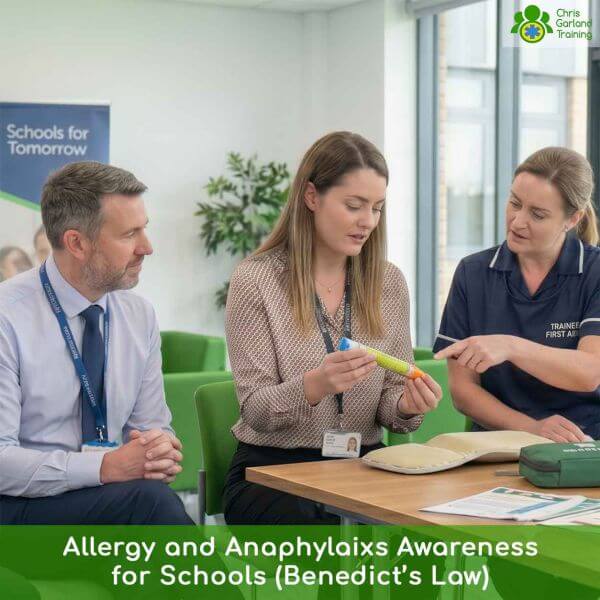
Allergy and Anaphylaxis Awareness for Schools (Benedict’s Law)
From 1 September 2026, maintained schools, academies and pupil referral units in England must have a published allergy safety policy and have regard to the Department for Education’s Allergy safety in schools guidance.
Allergies are common. About two children in every classroom have a diagnosed food allergy and around one in five severe reactions happen at school. First aiders alone are not enough as a reaction can start in a corridor, dining hall or playground.
This course trains the whole staff team in one session. You leave with practical skills, a clear view of what the guidance expects, and evidence of training for governors and inspectors.
What Schools Must Have in Place
- A dedicated allergy safety policy, published on the school website and reviewed at least once a year
- Allergy awareness and emergency response training for all staff who work with pupils
- Individual Healthcare Plans and Allergy Action Plans for pupils who need extra arrangements
- Rapid access to prescribed adrenaline, plus spare auto-injectors held for emergency use (suggested suppliers list)
- A system to record incidents and near misses and to learn from them
Who Is This Training For?
Allergy safety is a whole-school duty. Book the people who will be first on scene, not only the first aid team.
- Teaching teams: class teachers, HLTAs and teaching assistants
- Early years and wraparound: nursery practitioners, breakfast and after-school staff
- Support and facilities: lunchtime supervisors, playground staff and catering teams
- Operations and admin: office staff, site teams and school transport drivers
- Leadership and governance: headteachers, DSLs, business managers and governors
Who Benedict’s Law Applies To
The statutory allergy safety policy duty applies now to:
- Maintained schools: local authority primary, secondary and special schools (not maintained nursery schools)
- Academies and free schools: including alternative provision academies (not 16 to 19 academies)
- Pupil referral units
Independent schools should still train staff and hold spare devices. Equivalent duties are expected to follow through their own regulatory route.
Course Content
- The development of Benedict’s Law
- What is an allergy?
- Mild allergic reactions
- Anaphylaxis: recognition and the ABC approach
- Anaphylaxis: emergency response
- Understanding adrenaline medication (AAIs and EURneffy nasal spray)
- Biphasic anaphylaxis (second-wave reactions)
- Allergy Action Plans
- Storing and accessing adrenaline medication
- Allergies and associated health conditions
- Food hypersensitivity, including food allergy, food intolerance and coeliac disease
- Food labelling
- Roles and responsibilities
- Policies and documents
- Staff training
- Inclusion and safeguarding
- Communicating with parents and carers
Practical skills in the same session
- Correct use of trainer devices for EpiPen and Jext auto-injectors
- Correct use of the EURneffy nasal spray trainer
- When to give a second dose
- How a pupil’s own prescribed EURneffy sits alongside the school’s spare auto-injectors
- Basic life support and AED use during an anaphylactic emergency, following Resuscitation Council UK 2025 guidelines
EURneffy is licensed in two strengths: 1 mg for children aged 4 and over who weigh 15–30 kg, and 2 mg for people who weigh 30 kg or more. Spare school pens are still held under the 2017 medicines rules and the 2026 DfE guidance.
Legal Context and Guidance
The course maps to current education and medicines rules. Completing it gives you a staff training record you can show governors and inspectors. It does not replace your duty to publish a policy, hold spare devices or write Individual Healthcare Plans.
- Benedict’s Law: section 34 of the Children’s Wellbeing and Schools Act 2026 and section 100A of the Children and Families Act 2014. Schools must have, publish and review an allergy safety policy.
- DfE statutory guidance: Allergy safety in schools (July 2026), including whole-staff training, Individual Healthcare Plans and spare adrenaline auto-injectors.
- Supporting pupils with medical conditions at school
- Human Medicines (Amendment) Regulations 2017: purchase and emergency use of spare adrenaline auto-injectors
- Equality Act 2010: reasonable adjustments and non-discrimination
- Resuscitation Council UK 2025 guidelines: CPR and AED use in an anaphylactic emergency
Attendance Continuity and Late Arrival Policy
We and the awarding bodies that we are affiliated with enforce strict contact-time criteria for training courses. You must arrive fully prepared for each interactive module. If you arrive more than 15 minutes late, we must turn you away. As a result, you will forfeit your place and all paid booking fees.
How We Deliver It
- Four hours, timed around the school day. Morning, afternoon or twilight on your site. Open courses also run at our Knutsford centre.
- A private school booking is usually the better option. We train the whole staff together, walk the real kit locations and set scenarios around your dining hall, playground and off-site visits.
Assessment
- Written paper: 15 multiple-choice questions. Pass mark 70%.
- Practical: you must show the correct emergency sequence and use of an adrenaline auto-injector or EURneffy trainer, plus CPR and AED if the scenario requires it. Practical pass mark 100%.
Who Can Attend
- Minimum age 14. Learners aged 14 to 16 can gain the certificate. An employer must not treat them as the sole responsible person.
- Teaching and assessment are in English. As a guide, Level 2 Functional Skills or GCSE Grade 4 literacy helps. Contact us before booking if you need a reasonable adjustment.
- Open courses need a minimum of six learners to run. We cap groups at 12 learners per instructor so everyone gets proper time on the devices.
Venues and Private Bookings
- Open courses run at our training centre in Knutsford, Cheshire. Read the joining instructions for directions and parking.
- For a private course on your site, request a quote on our Corporate and Bespoke Training Quotations page.
- If e-learning first would work better for your staff, see the blended Benedict’s Law course.
Related Training and Compliance Guides
- Blended option: Allergy and Anaphylaxis Awareness for Schools (Benedict’s Law) | Blended
- Early years: Level 2 Award in Food Allergy Awareness – Early Years | E-learning
- General e-learning: Level 2 Award in Food Allergy Awareness | E-learning
- Kitchen leads: Level 3 Food Allergy Management for Managers and Supervisors | E-learning
- Emergency hardware: Are defibrillators a legal requirement for UK businesses?
- Inclusive safety: Case study: developing inclusive evacuation competency in schools