
At A Glance:
TL;DR: The Key Changes at a Glance.
To begin, the Resuscitation Council UK 2025 guidelines are now the official standard for life-saving care across the United Kingdom. If you need to satisfy your HSE first aid requirements 2026 UK protocols, you must update your practices immediately. Here is the quick summary of what you must do differently right now:
• Call 999 Earlier: In adult basic life support, call 999 immediately upon finding an unresponsive person. Do not wait to check their breathing first.
• Spot New Signs of Arrest: Be alert for unique signs like "panting" in athletes or a brief period of seizure-like activity immediately after a collapse. Treat these as cardiac arrest.
• Prioritise AED Placement Over Dignity: You must remove a bra or undergarment if it prevents correct defibrillator pad placement. Do not delay a life-saving shock due to dignity concerns regarding bare skin.
• Remove Skin Colour Checks: Do not rely on looking for blue or pale skin to assess circulation in children. Instead, look for active signs of life and normal breathing.
• Adjust Defibrillator Pad Placement: Ensure the left lateral defibrillator pad is placed mid-axillary, which means directly under the armpit.
Introduction to the 2026 Safety Landscape
If you are managing first aid provisions or working as a responder in 2026, you are likely operating under the training you received a few years ago. However, the landscape of life-saving care has shifted.
The Resuscitation Council UK (RCUK) 2025 Guidelines are now the mandatory benchmark. While the previous 2021 guidelines focused heavily on safety during the pandemic recovery, the current updates prioritise speed, inclusivity, and the mental health of the rescuer. Whether you are a layperson, a designated workplace first aider, or a healthcare professional, this complete guide outlines exactly what you need to do differently.
Table of contents
- Introduction to the 2026 Safety Landscape
- Adult Basic Life Support: A Major Shift in Sequence
- Paediatric Basic Life Support: Inclusivity and Accuracy
- Immediate (ILS) and Advanced (ALS) Life Support Updates
- Summary: Your 2026 Checklist
- Choosing the Right First Aid Training Course
- Final Thoughts
- Frequently Asked Questions
Adult Basic Life Support: A Major Shift in Sequence
The most significant change in the current guidelines alters the very first steps you take when you discover an unresponsive casualty.
1. The “Call First” Rule
Previously, first aid training emphasised checking a casualty’s breathing before calling emergency services. To reduce life-threatening delays, this sequence has been reversed.
- The New Protocol: If you find a person who is unresponsive, call 999 immediately. Crucially, you must place this call before you attempt to assess their breathing.
- The Logic: Recognising abnormal breathing can be exceptionally difficult and time-consuming under pressure. By calling immediately, you get an emergency call handler on the line who can assist you with the assessment. Consequently, if you have a mobile phone, place it on speakerphone, dial 999 immediately, and then begin assessing the casualty’s breathing.
2. Recognising Cardiac Arrest: Panting and Seizures
The older guidelines focused heavily on spotting “agonal gasps.” Conversely, the current updates clarify what abnormal breathing actually looks like across different contexts, specifically in athletic environments.
- Athletes: Be aware that following a sudden cardiac arrest, an athlete may display a distinct “panting” breathing pattern or near-normal breathing for a short time.
- Seizures: Furthermore, a short period of seizure-like activity is incredibly common immediately after the heart stops beating. Once these brief seizure-like movements stop, you must immediately assess for breathing. If the casualty is unresponsive and breathing abnormally, assume cardiac arrest and start CPR.
3. The Team Member on the Phone
The emergency ambulance call handler is no longer viewed merely as a voice on the line. The current guidelines formally recognise the call handler as a vital member of your physical rescue team.
- Finding an AED: Call handlers now have direct access to The Circuit, the national defibrillator network. If you are not alone, the operator will immediately direct a bystander to the nearest registered public device.
- CPR Support: If you are untrained, the handler will guide you through compression-only CPR. Alternatively, if you are a trained first aider who can confidently perform rescue breaths, inform the handler. They will then fully support you in performing the standard 30:2 CPR ratio.
4. AEDs: Inclusivity and Clothing
The current framework tackles practical, real-world barriers to using an Automated External Defibrillator (AED), specifically regarding casualty clothing and signage.
- Bras and Underwear: There is now explicit guidance regarding undergarments. To ensure the defibrillator pads make direct contact with bare skin, you must remove a bra if it interferes with pad placement. Do not delay life-saving shock delivery due to concerns about exposing the casualty’s chest.
- Clearer Signage: Additionally, you should audit your facilities. Workplace AED signage should now explicitly state that no formal training is needed to use the device, encouraging bystanders to act fast.
5. Support for the Rescuer
Finally, a vital addition for the modern workplace involves the mental health of the responder. Attempting resuscitation can be a deeply traumatic experience. Therefore, the guidelines now state that organisations should actively offer psychological support and debriefing to lay rescuers and bystanders following an incident.
Paediatric Basic Life Support: Inclusivity and Accuracy
For individuals working with children and infants, the current guidelines introduce objective changes to make emergency assessments highly specific.
1. New Age Group Categories
For the last few iterations of the Resuscitation Guidelines, paediatric first aid covered just two broad groups: infants and children. The current guidelines refine these boundaries into four distinct groups to match human development:
- Infants: Aged 0 to 1 years old.
- Children: Aged 1 to 12 years old.
- Adolescents: Aged 13 to 18 years old.
- Adults: Aged 18 years and over.
2. Removing “Skin Colour” from Assessment
Historically, rescuers were taught to look for cyanosis (blue skin) or pallor (pale skin) as primary indicators of poor circulation. The newborn and paediatric guidelines have now removed the emphasis on skin colour.
Relying on skin colour changes is highly subjective and fundamentally unreliable across different ethnicities and dark skin tones. To ensure absolute inclusivity, rescuers must ignore skin colour and focus entirely on objective signs of life, breathing patterns, and responsiveness.
3. Simultaneous Assessment
Speed is critical during a paediatric arrest. Consequently, you should no longer treat physical assessment as a slow, linear checklist. You must actively assess for signs of life and circulation simultaneously while evaluating the airway and delivering initial rescue breaths. If you observe no clear signs of life, start chest compressions immediately after your first breaths.
4. AED Pad Placement for Children
The guidelines clarify exactly where to place defibrillator pads based on the physical size of the young casualty:
- Under 25kg (Approximately 8 Years Old): Use the Anteroposterior position. This means placing one pad in the center of the chest and one pad on the back between the shoulder blades.
- Over 25kg: Use the standard adult Anterolateral position, placing one pad below the right clavicle and one pad over the left axilla.
- Adolescents: When utilizing Anteroposterior placement on developing adolescents, take care to avoid placing the pads directly over breast tissue.
5. Critical Resuscitation Adjustments for Adolescents
The guidelines emphasize that while an adolescent may physically look like an adult, their resuscitation needs remain distinct. When transitioning from Immediate (ILS) to Advanced Life Support (ALS), practitioners must adapt their techniques using specific thresholds:
- The “Rule of Five”: For any patient under 18, including adolescents, the absolute priority is oxygenation. Always begin paediatric CPR with 5 initial rescue breaths. Most cardiac arrests in young people are respiratory (hypoxic) in origin, making this a life-saving differentiator from adult cardiac arrest.
- Compression Technique: Once a patient reaches adolescence, move away from the paediatric “one-third chest depth” rule. Instead, utilize the adult standard of 5 to 6 cm depth to ensure adequate blood flow to vital organs.
- Drug Dosages (ALS Only): In Advanced Life Support settings, drug dosages (such as Adrenaline and Amiodarone) transition from complex weight-based calculations to fixed adult doses once the patient is identified as an adolescent, provided they have reached a sufficient physical size.
[Adolescent Patient (13-18)]
│
├─► 1. Start with 5 Initial Rescue Breaths (Hypoxic Priority)
├─► 2. Use Adult Compression Depth (5-6 cm)
└─► 3. Transition to Fixed Adult Drug Doses (If sufficient physical size)
6. Suction-Based Choking Devices
You may have seen suction-based anti-choking devices marketed heavily on social media recently. The official verdict from the guidelines is clear: there is currently insufficient clinical evidence to recommend for or against these devices. Workplace first aiders must continue to use the standard protocol of back blows followed by abdominal or chest thrusts.
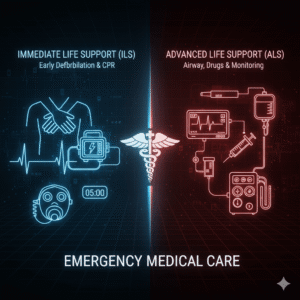
Immediate (ILS) and Advanced (ALS) Life Support Updates
For healthcare professionals, clinical staff, and those trained in advanced emergency response, three technical changes must be implemented immediately:
Temperature Management: The approach to post-resuscitation care has been significantly simplified. Clinicians are no longer targeting a strict, cold cooling range (such as 33°C). Instead, the goal is to actively prevent fever by keeping the core temperature at or below 37.5°C for comatose patients.
Lateral Pad Placement: Ensure the lateral (apical) defibrillator pad is placed precisely below the armpit in the mid-axillary line. Incorrect or shallow placement remains a leading reason for failed defibrillation attempts.
Video Laryngoscopy: If you are fully trained and the equipment is available on site, video laryngoscopy is now preferred over traditional direct laryngoscopy for advanced airway intubation.

Summary: Your 2026 Checklist
To ensure your business or school remains fully aligned with the latest clinical standards, complete these four steps:
Mental Health Support: Create a formal post-incident support protocol to care for the mental health of your staff if they ever have to perform CPR.
Update Drills: Update your internal emergency drills to train staff to Call 999 First before checking a casualty’s breathing.
Audit AED Stations: Check that your AED signage explicitly reads “No training needed” and ensure your device is fully registered on The Circuit database.
Review First Aid Policies: Remove all references to “skin colour” checks from your paediatric and child protection first aid protocols.
Choosing the Right First Aid Training Course
Skills fade much faster than theoretical knowledge. If you or your team completed your qualifications under the older 2021 guidelines, now is the time to update your practical skills. We provide clear training pathways to bring your business up to code effortlessly.
For General Workplaces & Offices
To learn the latest adult BLS sequence and get hands-on practice with the new guidelines, book our Emergency First Aid at Work (1 Day) course or our comprehensive First Aid at Work (3 Days) programme.
For Schools, Nurseries, & Childminding Settings
If you manage safety for children and need to master the new age categories and inclusive assessment techniques, our Paediatric First Aid courses are fully compliant with both the DfE and the latest resuscitation frameworks.

Final Thoughts
Skills fade faster than knowledge. If you trained under the 2021 guidelines, now is the time to refresh your practical skills.
Contact Chris Garland Training today to book your 2025-compliant first aid training course.
Frequently Asked Questions
The Resuscitation Council UK published the guidelines in late 2025. Compliant first aid training providers, including Chris Garland Training, fully implemented these standards in all public and corporate courses starting from January 2026.
No. The standard ratio remains 30 compressions to 2 rescue breaths (30:2) for adults if you are trained to deliver them. However, the guidelines emphasise that if you are untrained or unable to perform rescue breaths, you must perform continuous, uninterrupted chest compressions.
Yes, if it interferes with correct pad placement. Defibrillator pads must contact bare skin directly. You should remove a bra if necessary to ensure the shock is delivered effectively; do not delay life-saving treatment due to concerns about modesty or dignity.
The assessment of circulation has changed to be completely inclusive. Rescuers should no longer look for “skin colour” (such as blue or pale skin) as a primary sign, as this is subjective and unreliable across dark skin tones. Assessment must focus on breathing, signs of life, and responsiveness.
The guidelines state there is currently insufficient evidence to recommend for or against the use of suction-based anti-choking devices. Consequently, you must continue to use the standard, proven protocol of back blows and abdominal thrusts.
You must assess them carefully. A short period of seizure-like activity is very common at the start of a sudden cardiac arrest. Once the seizure-like movements stop, immediately assess for breathing. If the person is unresponsive and breathing is absent or abnormal (including gasping or panting), assume it is a cardiac arrest and start CPR immediately.
Yes. If a child is unresponsive and not breathing normally, you should use an AED. For children under 25kg (approximately 8 years old), you should use a paediatric mode or paediatric pads if available. If these are not available, use the standard adult mode. For small children, ensure the pads do not touch; you may need to place one on the front of the chest and one on the back.
Tourniquets are explicitly included in the first aid guidelines. You should apply a tourniquet for life-threatening bleeding from a limb that cannot be controlled by direct manual pressure. Place it 5 to 7 cm above the injury (not over a joint) and tighten it until the bleeding stops.
This applies directly to Heat Stroke. If someone shows signs of heat stroke (confusion, agitation, high core temperature), you must cool them immediately before the ambulance moves them. The most effective method is whole-body cold water immersion up to the neck. If that is not possible, use ice packs, wet towels, and fans until their symptoms improve.
It depends on the age of the casualty. If you are alone with no mobile signal, follow these rules:
• Adults: Shout for help, assess breathing, and if necessary, leave the victim to call 999 immediately. Then return to start CPR.
• Children/Infants: Perform CPR for 1 minute first, then leave to find a phone to call 999. This is because respiratory issues are the most likely cause of arrest in children, making early CPR critical.
To protect the spine. If a person has a suspected spinal injury (such as from a fall or a road accident) and is unresponsive but breathing normally, you should not move them into the recovery position unless their airway is at immediate risk from vomiting. Instead, use a “jaw thrust” to keep the airway open while they remain flat.
