
At A Glance:
TL;DR: Food Safety Compliance at a Glance
If you are short on time, here is the essential compliance summary for food business operators:
• The System: Hazard Analysis and Critical Control Points (HACCP) is a preventative safety system.
• The Law: Implementing a food safety management system based on HACCP is a legal requirement under the Food Hygiene (England) Regulations 2013.
• The Goal: To identify biological, chemical, physical, and allergenic risks before they reach the consumer.
• The Checklist: Compliance relies on daily temperature logging, strict hygiene controls, and a documented corrective action paper trail.
HACCP: The Scientific Guardrail of Food Safety
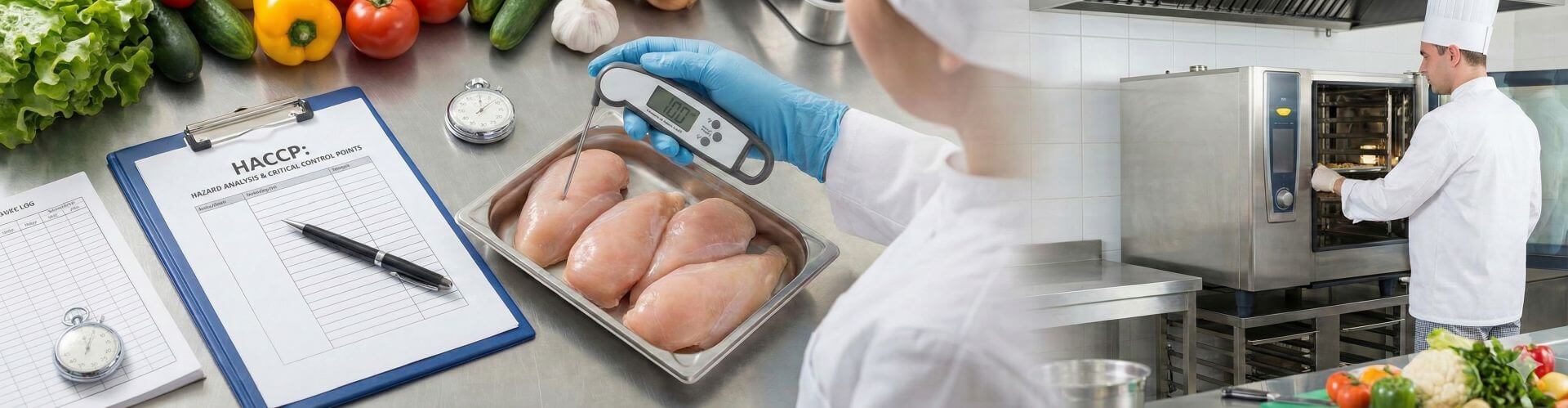
To protect your customers and maintain legal compliance, every commercial kitchen must follow strict HACCP food safety regulations UK laws. Specifically, under current statutory frameworks, running a food business means you must understand what are the 7 principles of HACCP and implement them daily. This science-based framework moves your kitchen away from reactive, end-product testing. Instead, it creates a proactive safety shield across your entire food production line.
Table of contents
- HACCP: The Scientific Guardrail of Food Safety
- Where Did HACCP Come From?
- The Legal Requirement in the UK
- The 7 Principles of HACCP
- Practical Outcomes: Hazard Analysis in Action
- Your Daily HACCP Monitoring Checklist
- Managing Mistakes: The Corrective Action Log
- Choosing the Right HACCP Training
- Frequently Asked Questions
Where Did HACCP Come From?
The history of HACCP is quite unique. It was not originally built for standard high-street restaurants or cafes. In the 1960s, NASA needed a bulletproof system to ensure that food designed for astronauts was 100% safe. A single case of food poisoning in a space capsule would have caused a total disaster for the entire mission.
From Space to Earth
To solve this issue, the Pillsbury Company worked closely with NASA. Together, they built a proactive system that focused entirely on preventing hazards during production rather than testing food at the very end. This innovative approach worked so well that it eventually became the global gold standard for commercial food safety on Earth.
The Legal Requirement in the UK
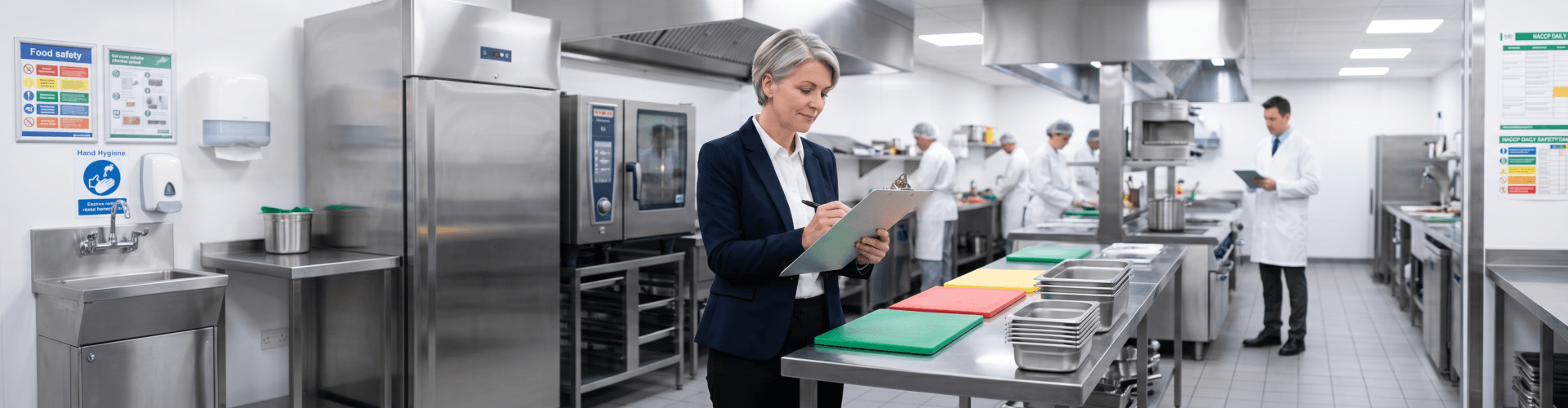
In the UK, food safety management is not just a recommendation: it is an absolute legal obligation. Under The Food Hygiene (England) Regulations 2013 and parallel legislation in Scotland, Wales, and Northern Ireland, all food business operators must implement and maintain permanent procedures based on HACCP principles.
Satisfying the EHO
Following these rules ensures you satisfy the high benchmarks expected by Environmental Health Officers (EHO) during unannounced inspections. Consequently, maintaining a functional HACCP plan protects your business from severe penalties. These penalties can include heavy fines, emergency closure orders, and criminal prosecution.
The 7 Principles of HACCP
To build a fully compliant food safety system, you must follow seven logical, systematic steps. These steps help you identify and manage biological, chemical, physical, and allergenic hazards before they harm your guests.
1. Conduct a Hazard Analysis
Look closely at your daily processes from delivery to service. Find exactly where things could go wrong, such as the multiplication of harmful bacteria on raw poultry.
2. Identify Critical Control Points (CCPs)
Find the specific stages in your process where you must apply an absolute control measure. This step is vital to prevent, remove, or reduce a safety risk to an acceptable level.
3. Set Critical Limits
Establish clear, measurable safety boundaries for each identified CCP. For instance, a standard critical limit is ensuring that a cooked meat item reaches a minimum core temperature of 75°C.
4. Monitor Your Limits
Establish a regular schedule to check that you are consistently meeting your critical limits. Specifically, this involves physical actions like checking fridge temperatures or using a calibrated probe thermometer.
5. Establish Corrective Actions
Have a clear, pre-planned protocol for what to do if a safety limit is missed. For example, if a hot food item drops below the safe holding temperature, your plan might state you must re-cook it or discard it safely.
6. Verify the System
Periodically review your safety data to prove your plan is actually working in the real world. This verification includes auditing your temperature sheets, checking calibration logs, and reviewing customer feedback.
7. Keep Accurate Records
Documentation is the absolute core of compliance. If you have not written it down, you cannot prove to an inspecting officer that your food is safe. You must store all monitoring logs securely.
Practical Outcomes: Hazard Analysis in Action
To understand how these safety principles work in a fast-paced kitchen, review this hazard analysis example for a standard beef burger. It demonstrates how a professional food business identifies and controls real-world risks.
| Process Step | Potential Hazard | Is it a CCP? | Control Measure |
|---|---|---|---|
| Delivery | Bacteria growth if meat is left too warm. | No | Check that delivery vehicles and meat arrive below 5°C. |
| Storage | Cross-contamination from raw meat to ready-to-eat food. | No | Store all raw meat on the bottom shelf of the fridge. |
| Cooking | Survival of harmful pathogens like E. coli. | Yes | Cook the burger until the core temperature reaches 75°C. |
| Service | Physical hazard from foreign objects entering the food. | No | Maintain a strictly clean, organized, and supervised prep area. |

Your Daily HACCP Monitoring Checklist
You can use the following structured checklist to ensure your daily kitchen operations stay safe, compliant, and completely audit-ready.
1. Temperature Control
- Fridge and Freezer Checks: Verify that all cold units are running at 5°C or colder for fridges, and -18°C or colder for freezers.
- Core Cooking Temperatures: Probe high-risk foods systematically to ensure they have safely passed the 75°C critical limit.
- Thermometer Calibration: Check your probe thermometer for accuracy using the boiling water or ice-water test method today.
2. Hygiene and Cross-Contamination
- Physical Separation: Ensure raw ingredients and ready-to-eat foods are prepared in completely separate zones using colour-coded boards.
- Handwashing Stations: Verify that all staff basins are fully stocked with warm water, anti-bacterial soap, and clean paper towels.
- Cleaning Schedules: Double-check that all daily cleaning tasks have been thoroughly completed and signed off in the master log.
3. Documentation
- Corrective Actions: If any safety limit was missed today, did you fully record exactly how you resolved the issue?
- Supervisor Verification: Ensure a kitchen supervisor or manager has reviewed today’s logs for absolute accuracy.
Managing Mistakes: The Corrective Action Log
Even with the best training and planning, mistakes can occasionally happen in a busy commercial kitchen. HACCP Principle 5 requires you to have an explicit plan for these exact moments. A Corrective Action is simply the practical step you take to ensure no customer gets sick when a safety limit is missed.
If an Environmental Health Officer visits your premises, they will look specifically for your Corrective Action Log. They want to see clear evidence that when a problem occurred, your team successfully identified it, fixed it immediately, and took preventative steps to stop it from happening again.
Example Corrective Action Template
You can utilise this layout to build your internal compliance folder:
| Date & Time | Issue Identified | Immediate Action Taken | Preventative Action (The Future Fix) | Signed |
|---|---|---|---|---|
| 02/02/26 09:00 | Fridge 2 temperature reached 9°C. | Moved high-risk stock to Fridge 1. Called refrigeration engineer. | Increased temperature checks to three times daily until unit is fixed. | J. Smith |
| 02/02/26 13:00 | Chicken core temp reached only 68°C. | Continued cooking until core temp reached the 75°C safety limit. | Retrained junior chef on oven pre-heating times and probe use. | J. Smith |
Why This Matters for Your Business
Documenting these kitchen errors is not an admission of business failure. On the contrary, it is a powerful demonstration of total management control. It proves to inspectors and insurers that your business is highly proactive and prioritises public safety above all else. This formal “due diligence” record is your strongest possible legal defence in a food safety dispute.
Choosing the Right HACCP Training
Effective equipment and paperwork are only useful if your team has the skills to use them correctly. We provide fully accredited, industry-recognised training pathways to help you build a robust food safety culture.
- For Frontline Food Handlers
- Our Level 2 HACCP Training course is the perfect match for frontline staff, chefs, and kitchen assistants. This programme covers the fundamental mechanics of the seven safety principles and explains how to execute daily monitoring tasks flawlessly.
- For Managers and Business Owners
- Our Level 3 HACCP Training course is specifically designed for supervisors, head chefs, and business owners. This advanced qualification teaches you how to design, implement, audit, and lead a full food safety management team within your organisation.
Frequently Asked Questions
Yes. UK law dictates that all food businesses, regardless of size, must have a food safety management system based on HACCP principles. However, if you run a small, low-risk business, your plan can be very simple. Many small cafes successfully achieve compliance by using the Food Standards Agency (FSA) “Safer Food, Better Business” pack, which simplifies the seven principles for smaller operators.
Food Hygiene training focuses on personal cleanliness, cross-contamination layouts, pest control, and general cleaning methods. Conversely, HACCP training focuses specifically on the management system itself. It teaches you how to map out your processes, locate risks, set critical temperature limits, and maintain the legally required paper trail.
There is no single statutory expiry date mentioned in the regulations. However, the general industry best practice is to keep your daily logs for at least an inspection cycle, which usually means at least two years. If you cater to high-risk groups or provide long-shelf-life products, keeping records for up to six years is advised to protect your business against historical due diligence claims.


