
At A Glance:
This case study examines a multi-year remote food safety training programme delivered to an NHS Trust, which achieved an outstanding 99.3% academic pass rate. By migrating final assessments to the Chamilo LMS, the rollout provided essential flexibility for busy healthcare staff while maintaining strict data security compliance.
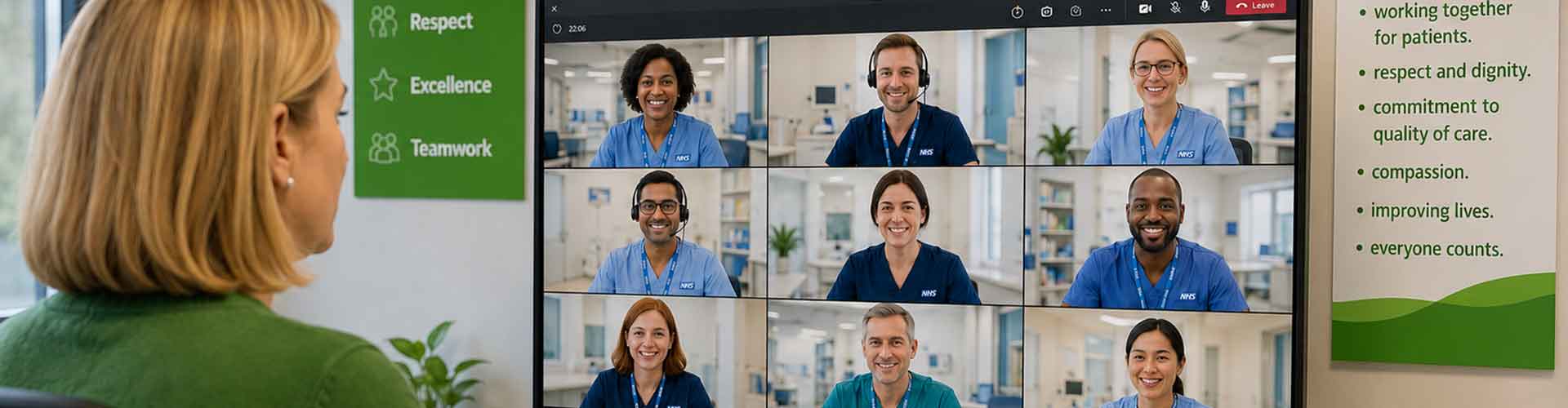
Case Study: Multi-Year Remote Food Safety Training for NHS Trust Staff
The Challenge: Eliminating the Logistics of Regional Training
Coordinating mandatory compliance training for hundreds of NHS Trust staff distributed across a massive regional footprint is a constant logistical headache. Traditional face-to-face classroom training means paying thousands in travel expenses, adding to carbon footprints, and forcing department managers to scramble for shift coverage. To solve this, the Trust required a flexible digital rollout. This solution needed to scale across multiple years without compromising on training quality, depth, or tutor interaction.
Table of contents
The Approach: Classroom Rigour, Digitally Delivered
1. Context-Driven Curriculum & Real-World Takeaways
We do not believe in rushed shortcuts or generic slide dumps. To begin, we re-engineered our face-to-face presentation to reflect the fact that candidates were learning from their own settings. Specifically, this remote food safety training curriculum directly addressed the unique food safety parameters of staff working across active healthcare environments as well as remote home settings.
As a result, the depth of the material remained completely uncompromised. Candidates explicitly noted in their feedback that they walked away with a significantly improved grasp of core legislation rules under the Food Safety Act 1990, distinct refrigerator temperature requirements, and practical cross-contamination controls. As one candidate noted:
“I was pleasantly surprised… I learned a lot more about how cross-contamination can be actively controlled.”
2. Guarding Against Screen Fatigue
To keep engagement high, we maintained our exact classroom pacing over MS Teams. Sessions ran from 09:00 until roughly 17:00, allowing a few minutes of leeway for the occasional internal IT glitch. We also strictly preserved our standard rest intervals: a 15-minute morning break, a 30-minute lunch, and a 15-minute afternoon break.
Live remote training can easily feel sterile, and multiple candidates highlighted that it is a “full-on day.” To counter this, we capped every single cohort at a strict 14-candidate maximum. This small-group structure allowed us to protect live discussion, ensure everyone had direct access to the tutor, and keep the environment supportive. Candidates reported that the session felt highly “interactive,” noting that:
“Chris was very knowledgeable and made everyone feel completely at ease and relaxed.”
3. Data-Protected Cohort Management & Secure Onboarding
Massive training rollouts should not create an administrative burden for L&D departments. While data protection is paramount across all sectors and for every client we serve, public sector healthcare providers operate under exceptionally rigid data governance frameworks. Because NHS internal security structures strictly limit the bulk transmission of staff details, we did not use open public enrollment. Instead, staff registered for course dates directly via the Trust’s internal systems, and their L&D team provided us with filtered baseline cohort lists incrementally to minimise data exposure.
To safely collect the mandatory student information required for official certification and exam setup, candidates completed their onboarding profiles using our own web-hosted registration forms. Because these forms run on our standard web infrastructure, which is natively protected by multiple layers of industry-leading security protocols, the Trust had full assurance that NHS personnel data remained completely insulated and compliant from day one. Once these profiles were logged, our automated systems handled the final dispatch, sending unique MS Teams meeting invitations and digital student manuals directly to the candidates ahead of their sessions.
4. Digital Assessment Evolution via Chamilo LMS
Over the course of this multi-year partnership, our delivery methods evolved to better serve candidate needs. In 2025, cohorts undertook traditional same-day examinations immediately following the lecture block. To improve flexibility, we migrated the assessment phase over to the Chamilo LMS for all subsequent cohorts.
This rollout reflects a core strategic upgrade for Chris Garland Training. As a business, we are actively migrating all paper-based examinations for our bespoke and in-house training courses over to the Chamilo platform to streamline delivery, improve accessibility, and automate compliance tracking. On this platform, candidates received a flexible four-week window to log in and complete their timed online examination. This structural change allowed busy healthcare professionals to balance their compliance requirements with unpredictable shift patterns, choosing to test when they felt most alert.
The Results: 99% Academic Pass Rate And Verified Compliance
The long-term data from this regional rollout highlights the exceptional instructional quality of the course alongside the real-world operational tracking metrics of a large public sector workforce:
- 99.3% Academic Pass Rate: Across the multi-year tracking data, a total of 136 candidates successfully achieved the 70% certification threshold. This represents a 99.3% academic pass rate among those who completed the examination, with only a single candidate missing the benchmark. Knowledge retention was exceptionally high across the board. Passing scores on the standard examination averaged an outstanding 92%, while the longer format cohort averaged 88%. Notably, over 21% of the standard cohort achieved a flawless, perfect score.
- Meticulous Operational Tracking: Our systems successfully tracked staff members who either timed out of their flexible four-week examination window (DNF) or could not attend the digital testing environment (DNA) due to intense NHS scheduling constraints, emergency cover requirements, and shift disruptions. This feature provided the L&D department with clear visibility over exactly which staff required reassignment.
- Audit-Ready Verification: Candidate feedback loops were fully automated. Every review was securely logged alongside unique IP addresses and explicit date stamps via our web automations, giving the Trust tamper-proof, verified data for compliance audits.
What the NHS Candidates Said:
“Great value training that actually makes you think about day-to-day practices in your own setting.”
“A very in-depth course. It gave me a much better knowledge of food safety legislation and real-world compliance.”
“Chris was wonderful, clear, and excellent at keeping the group focused. I thoroughly enjoyed the discussion.”
If you are coordinating compliance training for a large, distributed workforce and need a partner who understands secure data workflows, operational flexibility, and elite passing standards, we can help. Choose from our standard food safety courses or contact us to discuss a bespoke rollout for your team.