
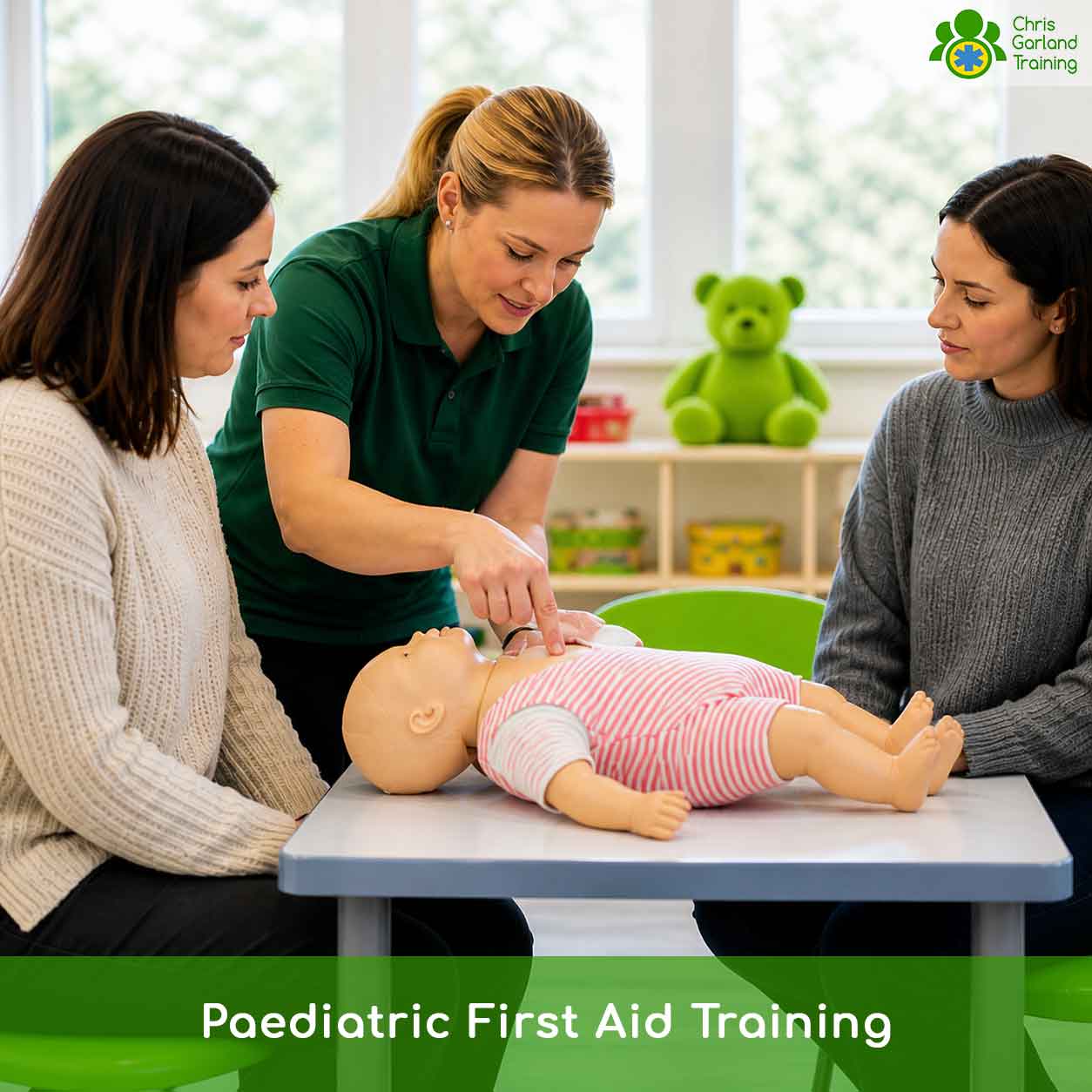
Paediatric First Aid — Face-to-Face Course
The qualification that keeps children safe, and keeps your setting compliant.
Children are not small adults. Their anatomy, physiology and the nature of the emergencies they experience differ meaningfully from adults, and so does the first aid response. A qualification in adult first aid does not make someone a competent paediatric first aider. The Paediatric First Aid (PFA) course exists precisely because children’s safety demands specific training.
For anyone working in an Ofsted-registered Early Years Foundation Stage (EYFS) setting, including childminders, nurseries, pre-schools and after-school clubs, holding a current Paediatric First Aid certificate is a statutory requirement under the EYFS Statutory Framework (DfE, 2023). The requirement applies specifically to staff counted within the statutory staff-to-child ratios at Level 2 or Level 3.
Two paediatric first aid qualifications: which one do you need?
- Emergency Paediatric First Aid (EPFA): a 1-day course (6 hours). Meets the requirement for EYFS staff who are not included in the statutory staff-to-child ratios.
- Paediatric First Aid (PFA): a 2-day course (12 hours). This is this course. It is required for anyone included in the statutory staff-to-child ratios at Level 2 or Level 3. It is also appropriate for childminders, sports coaches, outdoor education leaders, and anyone caring for children professionally.
If you are unsure which applies to your role, review the DfE EYFS Statutory Framework or contact us.
This course is also available as a blended learning option: approximately 8 hours of online pre-learning followed by 1 full classroom day, with the same qualification. View the blended learning option.
What You Will Learn
This 12-hour course covers the full QNUK Paediatric First Aid syllabus, aligned with UK Resuscitation Council guidelines (2025) and the DfE EYFS requirements:
Assessment and response:
- The role of the paediatric first aider in an EYFS or childcare setting
- Safe scene assessment and calling for help
- Consent and communication with children
Life-threatening emergencies:
- Infant CPR (0 to 1 years): technique, ratio and AED use
- Child CPR (1 to 18 years): technique, differences from adult CPR, and AED use
- Recovery position for an unresponsive infant or child
- Choking in infants and children: recognition and response
- Severe allergic reaction and anaphylaxis
Injuries and medical conditions:
- Wounds and bleeding, including external and internal
- Catastrophic haemorrhage control
- Burns and scalds: classification, cooling and covering
- Head injuries and concussion awareness
- Fractures and suspected spinal injuries
- Febrile seizures and epileptic seizures
- Asthma and respiratory distress in children
- Diabetic emergencies
- Meningitis: recognition and response
- Poisoning and ingestion
- Eye, ear and nose injuries
- Minor injuries, including cuts, grazes, bruises and splinters
Practical skills:
- Application of all skills above using infant and child manikins
- AED use on children
- Communicating with parents, carers and emergency services
Course Details
| Duration | 2 days, 9am to 5pm each day (12 guided learning hours) |
| Format | 100% classroom, with infant, child and adult manikins |
| Group size | Minimum 4, maximum 12 per instructor |
| Certificate | Valid for 3 years. CGT-issued (included) or QNUK Ofqual-regulated (an additional £12.50 per delegate) |
| Assessment | Multiple-choice paper (70% pass mark) plus full practical observation, including CPR on the floor (100% pass mark) |
| Language | English. Reasonable adjustments are available; please contact us before booking |
| Venue | Knutsford training centre, or at your premises nationwide |
| Age and prerequisites | Physical ability to perform CPR on the floor required. GCSE Level 1 literacy recommended. Recommended age 16+ |
Employer Responsibilities
Employers in Ofsted-registered EYFS settings are responsible for ensuring paediatric first aid certificates remain current. A certificate that has lapsed means the certificate holder no longer meets the statutory requirement for the staff-to-child ratio. Requalification must be arranged before expiry, not after. Contact us to discuss requalification options.
Certificate:
There are two options available for the paediatric first aid course. Ultimately there is no difference in the validity of either, but some people prefer to choose one other the other. You will see the same presentation, be assessed on the same practical skills & to the same degree, but sit different multiple choice exam papers at the end of the course.
- Certified by Chris Garland Training:
- This is the default option.
- PDF format certificates are issued as standard, but paper certificates can be requested as well.
- Your certificate is valid for 3 years.
- Certified by the Ofqual Regulated Awarding Organisation:
- If you’d prefer this option, please select this option when making your booking above.
- PDF format certificates are issued as standard, but paper certificates can be requested as well.
- Your certificate is valid for 3 years.
Course duration:
- The DfE & Ofsted state that for the course to be valid, your course must be a minimum of 12 hours in total duration. This includes the time allowed for the assessments and exam, but does not include for any coffee breaks.
- Minimum of 12 guided learning hours with a further 4 hours self study.
- Generally we run these courses from 9.30am until 5pm.
Test:
- Whether certified by Chris Garland Training or the Ofqual Regulated Awarding Organisation that we use, the paediatric first aid assessments are the basically the same. Each candidate undertakes a multiple-choice question paper & practical assessment.
- Multiple-Choice Question paper:
- You need to score a minimum of 70% correct answers to achieve a pass.
- Practical observation:
- You’ll need to demonstrate giving first aid as you would in an emergency situation, such as providing CPR on the floor. You need to score 100% to achieve a pass.
Pre-requisites:
- You’ll need to be able to demonstrate first aid procedures as you would in a real activity environment. This includes providing CPR to a casualty who is on the floor. So you must be physically capable of doing this to pass the course.
- We recommend that you have at least GCSE grade D/Level 1 English & Maths before undertaking this course. This is not mandatory – please contact us to discuss any reasonable adjustments to accommodate your needs.
- The course is suitable for anyone over 16 looking to undertake the responsibilities associated with being a nominated first aider. The course can also be undertaken by candidates between 14 & 16 years old, but they shouldn’t be relied upon by employers to be a sole, nominated first aider.
Candidates:
- All classroom courses have a minimum and maximum number of candidates that we can take on a course.
- Minimum: We need a minimum of 4 candidates on an open/scheduled course for the course to run. Click here for more details.
- Maximum: We are limited by the Health & Safety Executive, and (where applicable) by the Awarding Organisation, to a maximum of 12 candidates per instructor.
- Should you have more than 12 candidates to be trained, please contact us to discuss your training needs.
Geographical coverage:
- The paediatric first aid course is available to candidates in England, Wales and Northern Ireland.
- We can deliver it in other countries, but the protocols that we teach meet the current UK practice, protocols & guidance.
Venue:
- Scheduled paediatric first aid courses run at our training centre in Knutsford, Cheshire. Visit our Joining Instructions page to read about what you will need to bring/wear, etc.
- If you have chosen the blended learning option, you’ll need to attend our training centre to complete the face to face element of the course. Where a private booking has been made for multiple candidates using the blended learning option, please contact us to discuss holding the practical element of the course at your venue.
- Why not arrange to have a private face to face course run at your workplace? Simply fill in our quote builder tool to request a quotation.
Joining instructions:
- Visit this page to read the course joining instructions.
- Where your course is not being run at our main training centre, you’ll also receive an email with additional joining instructions including the venue address.
Private courses:
- To arrange a private course for yourself or your colleagues, please fill in our Quote Builder tool.
ChrisGarland –
Recent reviews collected directly after the course:
⭐⭐⭐⭐⭐ – “Good knowledge from Chris. A lot to take in!”
⭐⭐⭐⭐⭐ – “Excellent course. A lot of knowledge given; hopefully I won;t have to use all of it!!”
⭐⭐⭐⭐⭐ – “[no comments left]”
⭐⭐⭐⭐⭐ – “Good thorough course”
⭐⭐⭐⭐⭐ – “[no comments left]”
⭐⭐⭐⭐ – “Learnt new bits”
⭐⭐⭐⭐⭐ – “[no comments left]”
⭐⭐⭐⭐⭐ – “[no comments left]”
ChrisGarland –
Recent reviews collected directly after the course:
⭐⭐⭐⭐⭐ – “Excellent course!”
⭐⭐⭐⭐⭐ – “I’d highly recommend this course to a friend or colleague.”
⭐⭐⭐⭐⭐ – “Perfect!”
Jude –
The cost per person was very competitive
ChrisGarland –
Hi,
Following feedback from the staff who attended our recent Paediatric First Aid course I just wanted to pass on their comments.
They said the course was very possibly the best 1st aid training they had undertaken in many years and that the instructor, Jayne, was fantastic – informative, helpful and made the staff feel at ease. I know that all too often people are very quick to complain when something is not right, but often don’t acknowledge when something is done well – so thanks again, both to you and Jayne!.
Kind regards
Jude
Dodleston Pre-school.
Marie Guinness –
Good value .